
What remote patient monitoring includes — and what it returns.
The devices, the check-ins, the documentation — and the economics behind them. RPM pays on two fronts: protecting margins by preventing costly escalations, and unlocking recurring revenue from care you already deliver.
What’s Included
A remote patient monitoring program is more than a billing code.
Reimbursement requires device days, clinical time, and documented interactions. Here is everything that ships and everything that runs — the pieces the economics below are built on.
The core kit. All FDA-cleared.
Every deployment ships with three FDA-cleared Bluetooth devices, ready to monitor from day one.
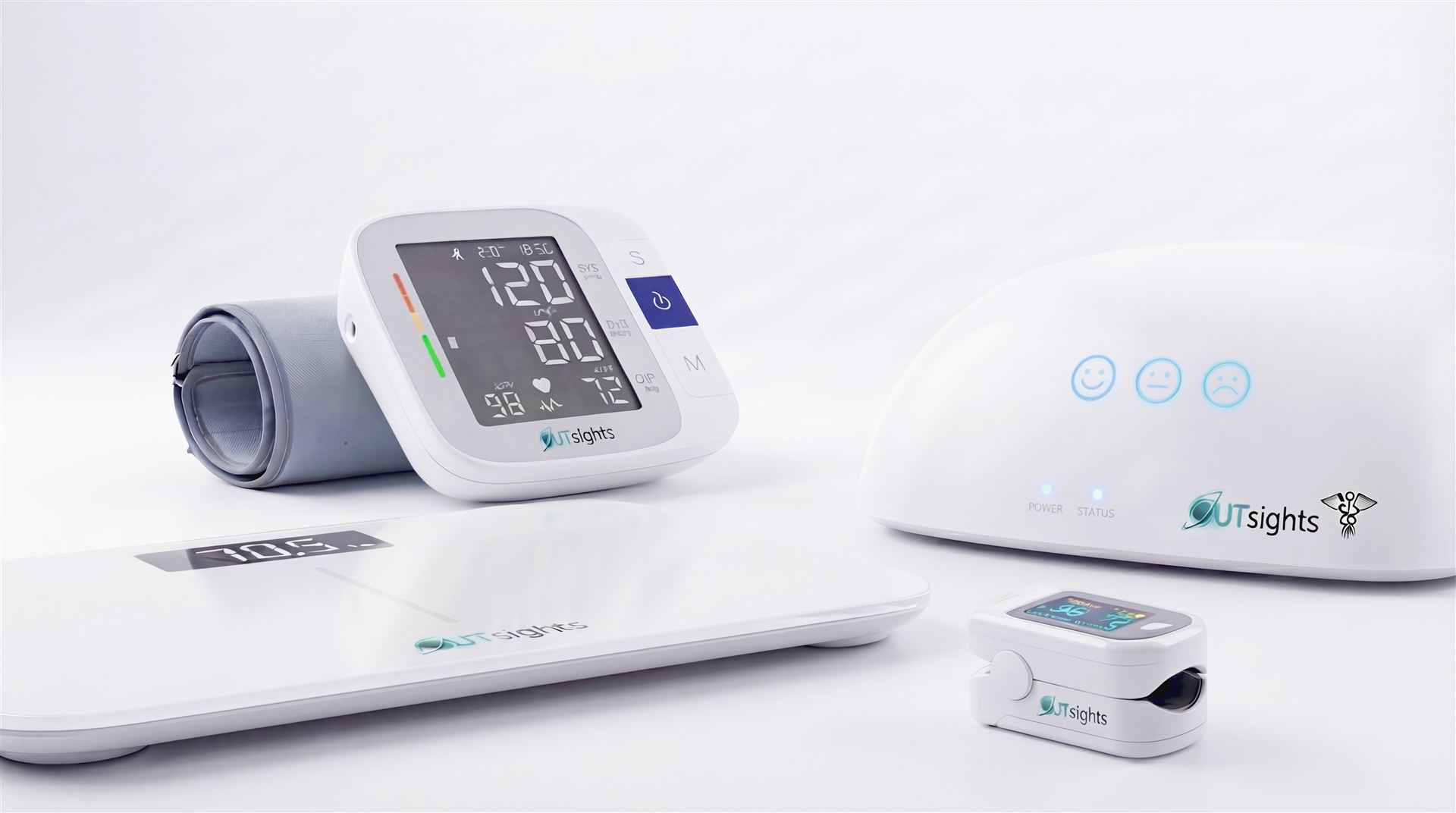
Digital Scale
Tracks weight trends that signal fluid retention, cardiac decompensation, and nutritional decline — automatically transmitted to the clinical dashboard.
Bluetooth • FDA-cleared
Automated Blood Pressure Cuff
Captures systolic, diastolic, and pulse rate. Alert thresholds configurable per patient — preeclampsia staging, hypertension management, and post-discharge monitoring.
Bluetooth • FDA-cleared • Clinical-grade oscillometric
Pulse Oximeter
Measures SpO₂ and heart rate. Critical for respiratory compromise detection, post-surgical monitoring, and chronic condition management.
Bluetooth • FDA-cleared • Real-time SpO₂ + HR
And everything the devices don’t capture.
Devices produce readings. Reimbursement — and better outcomes — require context, delivery, and proof.
Care Circle check-ins
Simple SMS check-ins to the patient and their caregiver — app optional, no login required — so decline shows up between readings, not after an admission.
Delivery into your EHR
Validated signal lands in Epic, Oracle Health, and athenahealth. No new portal for staff to check and no parallel workflow to staff.
Billing timers
Device days and clinical minutes tracked against billing code requirements as care happens — so nothing reimbursable slips, and nothing submitted lacks support.
Coverage anywhere
For homes without reliable broadband or cellular, the OUTsights Gateway keeps monitoring connected — turning unreachable patients into enrollable ones.
Master Your Unit Economics
Now the economics of that program, per patient. Build a patient profile below to calculate true Net Profit Margin after accounting for software, clinical triaging OPEX, and device CAPEX.
Unit Economics Modeler
Create Your Patient Profile
Build a profile below to test how adherence drives revenue, and see how the new 2026 CMS codes (CPT 99445 and 99470, finalized in the CY 2026 Physician Fee Schedule) capture partial revenue for missed time thresholds.
1Clinical Profile (Acuity)
Patients with 2+ conditions are modeled as High Acuity, unlocking CPT 99458 (+20 mins).
2Enrollment Fee
One-time patient onboarding & enrollment (~$150–$200 per patient).
Select a clinical condition to generate your Receipt.
Current State
The 500 patients in your area outside reliable broadband and cellular coverage:
No connectivity. No monitoring. No revenue.
With OUTsights Gateway
Those same 500 patients now generate:
Net Profit Annually
Range varies by acuity: 1 chronic condition vs. high acuity (2+ chronic conditions).
The Evidence
Explore the latest breakthrough clinical trials and economic audits that prove continuous care intelligence is no longer an optional add-on—it is a financial necessity for every forward-thinking practice, health system, and ACO.
Slashing the Systemic Cost of Care
The 2025 RMLC Study evaluated an aggregated dataset of over 100,000 monitored patients and 25 million biometric data points. The results were conclusive: continuous care stabilizes physiology and prevents expensive hospital-based interventions.
"For every $1 invested in the RPM program, the health system generated roughly $18 in downstream medical cost savings."
Median TCOC Decrease
Per patient, per year.
Scientific & Economic References
- American Heart Association (2025). Abstract 4369038: Remote Patient Monitoring Is Associated with a 30.6% Reduction in Annual Total Cost of Care. Circulation, 152(Suppl 3).
- Remote Monitoring Leadership Council (2025). Integrated Outcomes and Evidence Summary — 100,000+ monitored patients, 25M+ biometric data points.
- Zhang et al. (2025, NIH PMC). Program Cost and Return on Investment of a Remote Patient Monitoring Program for Hypertension Management.
- JMIR mHealth and uHealth (2025). Effects of RPM on Health Care Utilization in Patients With Noncommunicable Diseases: Systematic Review and Meta-Analysis of 40 RCTs.
- IntuitionLabs. Remote Patient Monitoring in the United States: 2025 Landscape Report.
- HealthArc (2026). Remote Patient Monitoring ROI in 2026: Costs, Benefits & Value for ACOs and Healthcare Organizations.
- JMIR Cardio (2025). Outcomes of Team-Based Digital Monitoring of Patients With Multiple Chronic Conditions: Semiparametric Event Study.
- Rockey-Bartlett et al. (2025, NIH PMC). Effect of remote patient monitoring on healthcare use among patients with cancer: A systematic review.
- Margosian et al. (2025). Impact of a Large-Scale Remote Patient Monitoring Program on Hospitalization Reduction. Telemedicine and e-Health.
- CMS (2025). Calendar Year 2026 Medicare Physician Fee Schedule Final Rule (CMS-1832-F) — new RPM codes 99445 and 99470, effective January 1, 2026.
Unlock Revenue. Improve Outcomes.
Ready to integrate the Care Circle Engine into your practice's workflow? Connect with our team.